

We are burning more coal than ever before in our history. More than we ever did in the Industrial Revolution, or during the 1970s global energy crisis.
Global coal demand likely rose by 0.5% last year to a record high of 8.85 billion tonnes, according to the International Energy Agency, led by China.
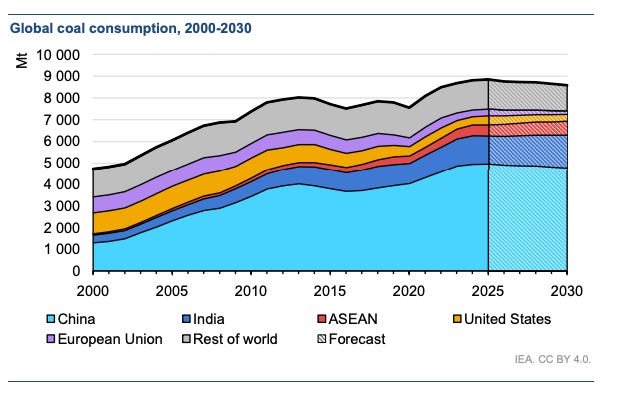
This is despite the the rapid decline in the cost of solar panels, wind turbines, and lithium-ion batteries over the past decade.
So why can’t the world quit coal?
Lucy Shaw, who writes the Slow Burn substack newsletter, is writing and researching a book on coal. She joined my monthly podcast, An Electric Revolution, to explain what is really going on. We discussed President Donald Trump’s efforts to revive the US coal sector; why India will find it hard to move beyond coal; and whether China can use coal-fired power plants to back up renewables, among other topics.
Below is an edited transcript of our conversation.
Listen on Spotify.
Listen on Apple podcasts.
Listen on YouTube.
Henry Sanderson: Thanks so much for joining me today. I’m delighted to have you on my podcast. I think one of the really interesting things about your research is that it tackles this dichotomy: we keep hearing that costs of renewables are getting ever cheaper, whether it’s solar or batteries, yet at the same time, we’re burning more coal than we ever have in our entire history. Coal demand is set to remain at record levels this year, according to the IEA.
I think what’s interesting in your work is the exploration of the reasons why we continue to burn coal—and that it might not all be to do with cost. I wondered if you could outline the thesis of the research going into your new book.
Lucy Shaw: Thanks for having me on the podcast, Henry. It’s really great to be talking to you about this. What initially got me interested in understanding the coal sector were these news reports about renewable costs coming down. Finally, we’re at a point where we can get reliable, cheap renewables that, in theory, should allow us to decarbonize the energy system while making it cheaper and more resilient.
So in recent years, it was surprising to me to note that coal consumption has grown and grown, reaching new peaks even as late as last year. This year might be different—though they’ve been saying that for several years now. My research is unpacking the reasons why coal might persist beyond the technical and economic constraints of the energy system itself. If renewables can deliver reliable power at a cheaper cost, then politics is a big factor in why coal might not phase out as quickly as some analysts think.
When I think about the politics of coal, they aren’t always “nefarious” politics. They can be very real constraints that governments and planners face in managing the economy. For the coal industry, there are several benefits it offers beyond just cheap electricity. I’ll talk about six of those:
Jobs: The job story is decreasing in importance in many countries because of mechanization and technology improvements, meaning we don’t need as many workers to get the same amount of coal out of the ground.
Foreign Exchange: Coal is often used in the country that mines it. Only about a sixth of coal is internationally traded. It tends to be a local fuel. Economics depend on that because it costs a lot to transport it the further away it is from a power plant. By keeping the energy system within your borders, you reduce the imports and foreign currency needs for energy.
Geopolitical Independence: Countries may have tonnes of foreign exchange, but they don’t want to be dependent on a foreign power for something as critical as energy.
Political Interests and Donations: I include in this category where politicians sometimes have interests in coal mining companies or coal-adjacent businesses. It also happens when political systems favor narrow voices with outsized representation for smaller communities. This is by design so smaller communities have a voice in national politics, but it can mean the interests of a small minority trump those of the majority.
Tax Revenue: Some countries own their own coal mines—India being a great example. It generates tens of billions in tax revenue from dividends, royalties, and income taxes, which can help subsidize other sectors like rail.
The Culture War Narrative: This is something I almost never hear “techno-optimists” talking about. Coal as a technology evokes stories of heroism, of people sacrificing great things for their community, and of a community spirit that has been eroded as the world modernized. Even if coal jobs aren’t as prevalent today, this idea that we want workers who are brave and perform backbreaking work and are imports pillars of society is an overlooked one in the story of coal and the overall transition.
Henry Sanderson: Thanks so much, Lucy. All of those points are fascinating. Just picking up on the United States, this is perhaps the most prominent example of politics trying to actually bring coal back. During Trump’s first term, he didn’t do very well and coal plants closed because of costs. But this time, like in so many other things, he’s determined to do better. He’s actually stepping in and preventing coal-fired power plants from retiring despite the additional costs. The IEA says coal demand in the US increased last year. Can he succeed, do you think, in actually bringing back what he calls “beautiful clean coal”?
Lucy Shaw: The American story is interesting because there are tailwinds at the moment that are helping the coal industry that haven’t been in place for the prior couple of years. A couple of those are by Trump’s design and some of them are external.
The two I would highlight: One of them is the explosion in electricity demand that the US, in particular, is seeing from data centers. And how it’s using that narrative to delay the closure of coal plants and also to increase the supply of all sorts of different fuels on the grid—not just coal, but gas, investigating geothermal, and bringing back retired nuclear plants even to make sure that these data centers have enough supply. That’s positive for the coal industry in the short to medium term until the supply issues shake out for the data center boom.
The second way that Trump’s energy policy supports coal is that he’s really pushed for gas exports via LNG. This has raised, unsurprisingly, the domestic price of gas because it now gets tied to international markets and reduces the supply available for local consumption. This makes coal more competitive against gas in some markets if gas prices have gone up.
Coal otherwise in the US has been in a structural decline for a very long time. Coal jobs have been in decline for decades, partly because power plants have reached their end of life and maintaining them is expensive. There isn’t an economic case for new coal power plants given where power prices and coal mining prices are. It’s also partly because of regulation to make coal less environmentally harmful and less harmful to human health, which has also changed where coal is sourced from the US. West Virginian and Appalachian coal and that region has gone down even as coal in the western US has become more prominent because they have different pollutants and therefore different costs at the power plant to mitigate against these.
Trump’s also rolling back some of these health regulations, both for power plants to make them cheaper and also for workers themselves, meaning they have fewer protections as they go to work in mining jobs. Not all of his policies are “pro-coal worker” in the sense that they don’t protect them from harms in the industry, but they do seem to be pro-coal in general. I think the trend of coal going out of the US energy system will in gernal continue, but Trump does have levers to support the industry, including rolling back taxes at a federal level.
“Not all of his policies are “pro-coal worker” in the sense that they don’t protect them from harms in the industry, but they do seem to be pro-coal in general. I think the trend of coal going out of the US energy system will continue, but Trump does have levers to support the industry, including rolling back taxes at a federal level.”
Henry Sanderson: Some of it’s obviously cultural, but how big and powerful is the coal lobby in the US? Obviously under Biden, I remember Senator Joe Manchin coming from a coal state was a big deal. How powerful is the lobby in pushing forward these policies?
Lucy Shaw: Senator Manchin is a super interesting character because he is a Democrat and the state of West Virginia is now very much a Republican state. What was interesting about him is how he became the holdout vote for Biden’s Inflation Reduction Act, meaning that he could secure investments that would benefit West Virginia in the energy transition. We forget about that kind of political power sometimes in regions that don’t have so much outsized power, where one Senate vote represents a state of 2 million people or so. That really changed the trajectory of the IRA; it meant that he was able to make sure it worked for communities in West Virginia. Now, that wasn’t enough to keep him popular especially given he was a Democrat candidate; he then became independent and didn’t run for re-election.
When I’ve spoken to people who are in and around that coal lobby, what they always tell me is that the oil and gas lobby is way, way larger. I believe it I think the oil and gas lobby has been a lot more effective at advocating for their interests than the American coal lobby. It helps that coal is so regionally concentrated—basically you have it in Appalachia and the Western US in Wyoming and nearby states. It means their political advocacy can be quite high, and they are very closely connected with elected representatives and civil servants in the states where coal is dominant.
So I do think there’s a strong coal lobby. I don’t think coal lobbying is necessarily the only reason Trump is supporting the coal industry. There is also this voter base and narrative around being anti-renewables, pro-coal, and anti-anything “woke” related to climate change that is more important than satisfying the interests of the coal lobby.
Henry Sanderson: Given power demand from data centers and higher natural gas prices, do you think Trump can succeed? By the end of this term, do you think coal is going to have a resurgence in the US?
Lucy Shaw: It’s already had a resurgence in the past year. It depends if you mean in absolute terms or in relative terms. I personally think coal will continue to decline in its share of electricity, not just in the US but all around the world. In relative terms, one could call that a decline. In absolute terms, there’s every possibility that coal stays at the level it’s at, which would then be a win for preventing its decline.
“It depends if you mean in absolute terms or in relative terms. I personally think coal will continue to decline in its share of electricity, not just in the US but all around the world. In relative terms, one could call that a decline. In absolute terms, there’s every possibility that coal stays at the level it’s at, which would then be a win for preventing its decline.”
There are a lot of states in the US that don’t expose electricity to market forces. In some of these states, it can mean that coal gets protected longer than it might otherwise survive on the electricity system. For example, I visited the Pleasants Power Station when I was in West Virginia.
This is a plant that is at the mercy of merchant prices, it wasn’t operating when I was there so it only comes on in extremely high periods of demand. But that’s unusual; a lot of the power plants are owned by utilities, and they choose whether they continue running them they make that decision based on economic grounds, but they can also be influenced by what the state wants. If there are upstream jobs in the coal mining industry in the coal mining industry in that state, studies suggest they’ll make investments in order to protect coal. It’s a fascinating way that mining industry interplays with the costs in the power sector.
Henry Sanderson: Moving to the other side of the world to China. The elephant in the room - consumes more coal than the rest of the world combined. China’s had an extremely impressive build-out of renewable energy—solar, batteries, wind—and they have ambitious targets. But at same time, they’re still building new coal-fired power plants. I keep hearing that perhaps these plants won’t be utilized all the time and can be backup power generation. I’m just curious whether coal plants can play that role given the costs of restarting them suddenly, or is it the case that China can pay for those costs? Is coal’s role in China shifting?
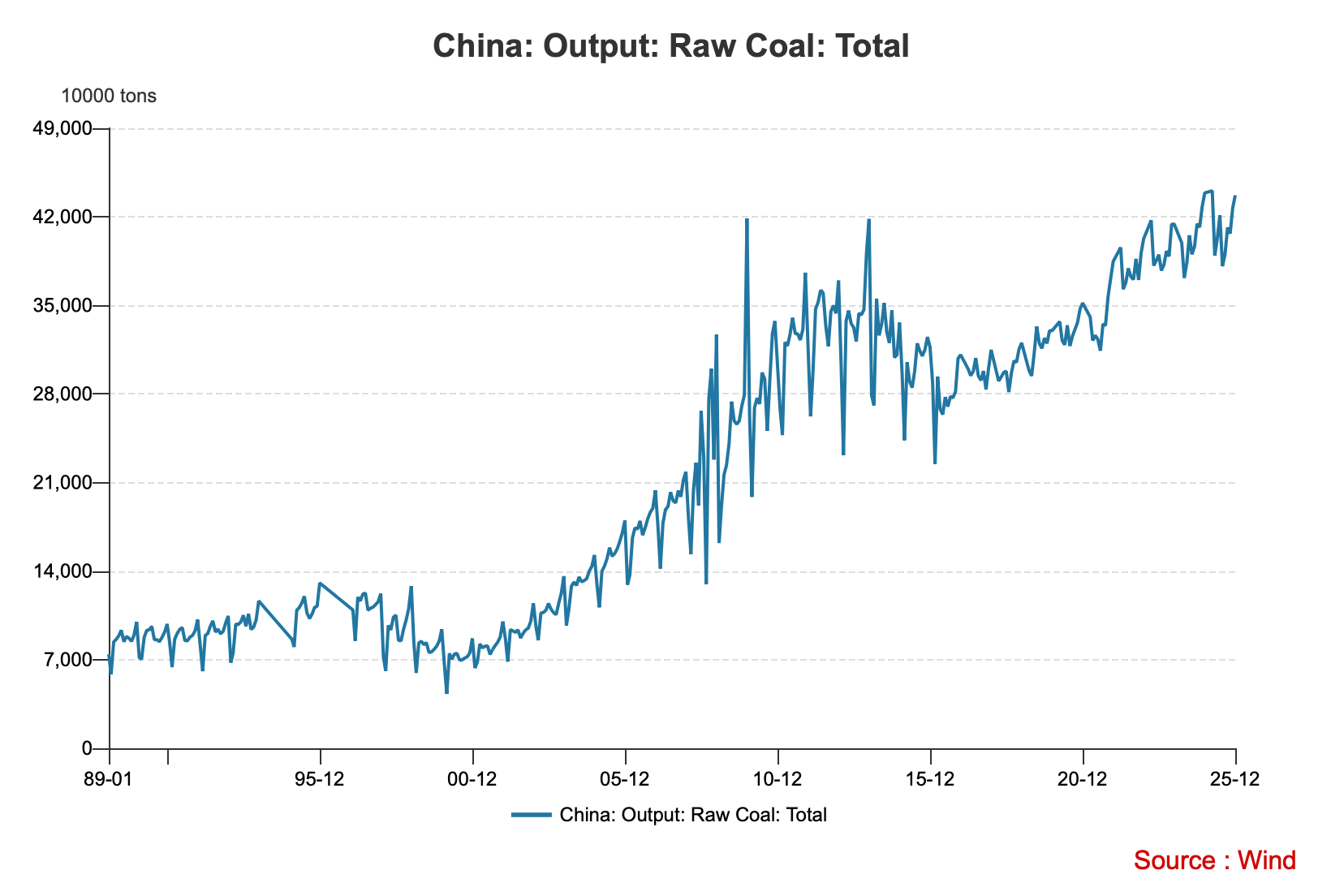
Lucy Shaw: Coal consumption in the power sector went down in China in 2025, which was landmark news last year. You can see why: they’re installing record levels of renewable energy and record levels of all sorts of generation technologies—nuclear and hydro as well. They’re building everything. I’m not surprised that power consumption would come down, at least in a single year. I’ll be interested to see if that trend continues this year.
What I find interesting about this narrative that coal could be used as a flexible power source is it depends what you really mean by flexibility. They don’t really mean that coal goes from zero to 100 the way that gas power plants can or batteries can deploy in the sector. They still need to maintain a base level of operations. In India, that’s above 50%; in China, they may get that down to 30% and ramp up from there. But that still means you’ve got 30% utilization of this enormous coal fleet. You then are not able to get rid of the emissions from that coal.
“What I find interesting about this narrative that coal could be used as a flexible power source is it depends what you really mean by flexibility. They don’t really mean that coal goes from zero to 100 the way that gas power plants can or batteries can deploy in the sector. They still need to maintain a base level of operations. In India, that’s above 50%; in China, they may get that down to 30% and ramp up from there. But that still means you’ve got 30% utilization of this enormous coal fleet. You then are not able to get rid of the emissions from that coal.”
This might also be deliberate so that you can keep coal mines in business and ramp down coal mining production over time instead of as quickly as market forces might dictate. What was interesting about coal power consumption going down last year is that coal production went up by 1%. This suggests stockpiling or other uses for coal. What’s troubling about China at the moment is the use of coal as a substitute for chemicals—making petroleum-based products out of coal, which is much more emissions-intensive than the current process but gives an offtake for coal mines as their power plant consumption goes down.
Henry Sanderson: That was surprising to me as well—seeing announcements of coal-to-chemicals plants. Is that an energy security concern from Beijing?
Lucy Shaw: I imagine it’s a few things. One of them is making sure that coal mines don’t collapse and go out of business overnight, which may happen if the power sector becomes fully liberalized. It’s not fully liberalized today and it’s not fully interconnected, which means even if you have massive renewable build-out, each province is still dependent on coal and incentivised to be so for energy security reasons.
The other reason is that it avoids importing hydrocarbons, which reduces dependence on foreign countries and protects foreign exchange. But then you would have to believe there’s some shadow price on imports on how geopolitically independent you want to be. And the price of carbon, by one report, is 20 times more intensive to use coal than imported petroleum. What shadown carbon price are they implying by switching to this system? I think there is a climate cost that isn’t being fully baked in and doesn’t seem to be in line with their commitment on emissions reduction.
Henry Sanderson: Coal is coming down in China, but are there technical things you see that can improve how coal is burnt, whether that’s blending it with other things or carbon capture and storage?
Lucy Shaw: I see carbon capture and storage as largely a distraction to keep burning coal. It’s not really an economic investment to make, nor will it be for many years, versus alternatives like stopping using coal. So I don’t see China pursuing that route with zeal.
One interesting development happening in India is using batteries to store excess coal production because it’s economic at current battery prices. It reduces fatigue on the coal plants and keeps them operating at their full potential, which then reduces emissions per unit because they’re not ramping up and down. It’s an interesting technical innovation, but I don’t think it helps you reduce emissions much in your energy system; it just helps India integrate more solar during the day. But you can see this potentially being used to keep coal on the grid longer.
“One interesting development happening in India is using batteries to store excess coal production because it’s economic at current battery prices. It reduces fatigue on the coal plants and keeps them operating at their full potential, which then reduces emissions per unit because they’re not ramping up and down. It’s an interesting technical innovation, but I don’t think it helps you reduce emissions much in your energy system; it just helps India integrate more solar during the day. But you can see this potentially being used to keep coal on the grid longer.”
It’s an interesting point blending coal with other fuels: you could imagine plants being retrofitted to become biomass plants. In the UK, we have Drax. It’s really not cost-effective to run that plant on biomass; they receive billions in government subsidies. It’s also not clear that it’s any better for the environment than coal. Some reports suggest Drax misreports the trees they use, and some are freshly cut rather than waste. I don’t see biomass or biomass mixing as a solution; I see it as part of prolonging coal use and making it more expensive than it used to be.
Henry Sanderson: Turning to India, big growth in coal demand is forecast there. You have a very interesting Substack post today about coal in India which typifies your points—overall there are not that many jobs, but they are very concentrated in certain areas. Do you see India continuing to increase coal or switching to renewables?
Lucy Shaw: I thought the jobs point in India would be the big story before I visited, but from talking to mine bosses, it really didn’t seem like that was on their mind... In fact, they are outsourcing and making sure that when people retire, they don’t backfill if machinery that they use can now cover the output.
What I found really interesting was the way coal supports government revenue and also the way land access is such a big driver of coal revenue. The government has the ability to take over coal land, pay people to leave, and then mine that resource. And you can quickly imagine that if they decided to move to a system that's fully renewable, that land would just sit undeveloped, that coal would sit unmonetized.
And maybe that would be the most economically reasonable thing to do. I mean, Britain decided not to dig up all of its coal, even though we have so much still sitting beneath the earth here, because it wasn't economic.
In India, it's still economic, at least for the time being. And so there's a push to acquire land, continue developing that land. And I visited this absolutely enormous coal mine in Odisha State, where people were on machines all throughout the mine, in like an orchestra of tiny ant-like diggers and trucks off in the hills.
“In India, it’s still economic, at least for the time being. And so there’s a push to acquire land, continue developing that land. And I visited this absolutely enormous coal mine in Odisha State, where people were on machines all throughout the mine, in like an orchestra of tiny ant-like diggers and trucks off in the hills.”
And that to me seems to be the future of Indian coal mining and actually coal mining in places like the US where you have these massive open-cut mines, very cheap to run, not that many jobs, but they can generate a lot of state revenue benefits from continuing to operate.
Now, renewables in India are cheaper than coal. Solar is and solar plus batteries increasingly so. And so power sector companies will be under pressure to procure more and more from renewable energy sources than from coal.
But because of the rents that the government has in the coal industry, they’re able to keep reducing taxes little by little if they wanted to keep coal cost-competitive with renewables and there’s quite a substantial amount of cushion that they have in being able to do that.
So I see last year’s decline in coal in India, which was quite substantial—coal power consumption declined 3% in a single year. I see that trend as potentially continuing.
The majority of that decline was due to the economy, not to renewables deployment. So lower growth than expected and also less heating-like demand.
But in general, this trend of more renewables is happening in India too. They’re building renewables like mad and they’re also promoting heavily a domestic manufacturing industry to support renewables growth.
I just think that industry is not yet there to deliver the import substitution benefits of coal and to deliver the state rents that coal offers. And so it will not be straightforward to just see coal chipped away three percentage points per year for the next 30 years. Even that, I think, would be ambitious, given the plans that mine leaders have to continue operating through to 2060.
Henry Sanderson: And that’s why you make an important point, which is they rely on Chinese solar and batteries. And this is a huge problem, right? And why we need to have more diversified supply chains, because presumably India doesn’t want to be completely reliant on China for these clean energy technologies.
Lucy Shaw: Exactly. When I’ve spoken to government officials, even before my visit, I query: well, if solar is cheaper, why would you not want that for your citizens so that they can have cheaper electricity? And the response was just that—that we don’t want to be overly dependent on cheap products from China. We’d rather have it be local Indian-sourced products. So if you can make solar like that and batteries like that, that’s amazing.
And I think what I’m quite interested in now is how much of that supply chain is still dependent on China, even if you have manufacturing facilities located in India. How much of the upstream inputs like raw materials, semi-manufactured materials that get put into the final product, is still coming from abroad and indeed even from China where they have geopolitical tensions even though they’re neighbors and both very large economies.
Henry Sanderson: So just bringing it back to the UK where we are. Obviously, the last coal-fired power plant closed. It’s been a remarkable story of moving beyond coal. I think I’m right in your own mother grew up in a coal community in the UK. How does the UK fit into your thesis that it’s not just about costs and economics?
Lucy Shaw: The UK story of coal fits into my thesis because we had a leader that despite the catastrophic impact she had on coal communities took a decision to let market forces prevail in coal mining.
She—and this is Margaret Thatcher I’m speaking about—went up against the coal unions in the UK against her arch-nemesis Arthur Scargill, head of the union. She decided to shut down British coal because it was more expensive than importing coal and ultimately driving up costs in the energy system. I’m sure she had other political reasons besides making electricity cheaper for British consumers, like being able to defeat a very powerful union and take out some of her opposition. But her decision to let that market force prevail, despite the economic devastation, I think was critical to exiting coal from the British power system.
There were other decisions later that also had a very positive impact, like introducing a carbon price. That instantly makes coal more expensive. It has twice as much carbon as its next most carbon-intensive competitor, gas. And when the UK started deploying lots of gas power plants, these were what helped to phase out coal because these were cheaper when you layer on a carbon price.
And then the third big action the government’s taken is promoting renewables through the Contract for Difference scheme and offering guaranteed contracts to make sure that power plants can get funding to get built, given that renewables are so capital-intensive to get onto the grid. So I think that story of going upstream and looking at the mining sector as a way to get rid of coal in the power sector is not one I hear told particularly often. I often hear people talk about at the power level that batteries and solar and all sorts of other technologies are cheaper than coal so eventually coal will go away without addressing these upstream considerations around jobs or the other macroeconomic benefits that I talked about.
And what I think the UK did really badly and what I’d like to also focus on in my book is managing that transition. They basically let it free fall. My mother’s town lost coal before the miners’ strikes. The last coal was mined there in 1973 and the peak miners’ strikes were in ‘84, ‘85. Her town doesn’t really have any local industry anymore. It’s a commuter town to Bristol and to Bath. People went to work at a local manufacturer, a bootmaker. They worked for the printmaker. But there wasn’t that much going on there. So the town died a little bit. And I think the devastation in the towns after the miners’ strikes and mass unemployment was huge and those communities in some ways haven’t fully recovered from that damage.
So I’d like to weave that story in to help people understand you can’t let this free fall, you have to plan for what happens to workers. When times are good, when you’re generating profits from coal, you may want to set up a fund to invest in what happens when the profits from coal go away and when those communities will need to find new jobs because the communities are often built around coal. They’re not built around big city hubs the way London is, where people can move into other jobs and sectors and there’s a skills agglomeration that attracts businesses. They’re just set up for coal mining and transitioning communities like that to other types of jobs is really difficult.
Henry Sanderson: So obviously we have coal used for power plants, which I think is your main focus, but we also have metallurgical coal used for making steel and other industrial processes. That’s much harder to decarbonize, I presume, than electricity generation. How do you see the decarbonization pathway for metallurgical coal?
Lucy Shaw: Yeah, so coal for electricity consumption is around two-thirds of demand for coal today. And that’s where I see the biggest prize for getting off coal is by reducing electricity demand for it, because other technologies are already cheaper. The other third is for coal in industrial processes of all kinds. Around one-eighth of coal is used for steelmaking and that kind of metallurgical use case and the rest is used in other processes including in this coal-to-chemicals world that we were talking about. That I do see as more challenging but it also represents a smaller portion of the total emissions.
What I find interesting is that we actually do have technologies to replace steelmaking with electrification—arc furnaces not using coal. And that technology is quite common already, but I think could be scaled up further. 70% of steel is still made with met coal and arc furnaces can pick up the rest, so 30%. We could be growing arc furnaces and then using electrification to make steel. And I think that’s a really promising development. But I do agree, it’s hard to imagine how the rest of the coal use cases can be decarbonized.
And what I see—how I see that impacting coal globally—is it will mean that countries with the highest quality coal will win and will stay in business. So Australia is a really good example of that. They have very high quality met coal and that’s a major part of their exports and they’ll stay in the market probably for that reason that their coal is the last coal you’ll want to get rid of because it’s much harder to replace in industrial processes.
Henry Sanderson: And just one region I realized we haven’t really talked about is Southeast Asia, where I think also coal demand is set to grow the remainder of this decade. I mean, you have countries like Indonesia, obviously big coal exporters, but they also have the nickel industry; they have on-site coal-fired power plants to power that industry. What’s happening in Southeast Asia? Are they going to continue with coal or will we see renewables become increasingly attractive?
Lucy Shaw: I think that renewables are increasingly attractive all around the world and in Southeast Asia. I would distinguish between countries that have a lot of domestic coal, like Indonesia, and countries that import coal, like Vietnam. I think that the political economy benefits of phasing out coal are much higher somewhere like Vietnam, which doesn’t have such an extensive domestic mining industry and is really then trading off decisions around cost, import currency, and foreign independence. There you may see contracts locking coal into the power system. There is really interesting work on the impact of how coal is contracted in keeping it online because you can’t get out of these contracts for 15 or 20 years. So adding a carbon price onto them can also mean costs just get passed on to consumers. It doesn’t necessarily lead to phasing out the coal.
But I think in general, renewables will help to displace coal over time in those importing countries, subject to being able to connect to the grid. I know several years ago, there was a lot of drama around connecting renewables to the grid in Vietnam in particular, because they had such a massive build out and then couldn’t get it to where demand was.
I think Indonesia is a massive coal story because they’re also one of the world’s largest exporters. They don’t use nearly as much coal domestically as they export. And there they’ve subsidized coal historically to make it cheap to use on the power sector. I think that will change because it costs money to subsidize coal and it will allow renewables to more effectively compete. It will also save more production for export. When I visited Indonesia as well and spoke to people there, including the head of a coal association, they’re very much planning for coal to remain in that country. They’re also baking in carbon capture as a way to keep coal, whether that happens remains to be seen.
And then you also have this point around political alignment with coal where politicians own coal assets and this can then influence how decisions are made. That is a story I heard quite commonly in Indonesia. But even without getting into that, there’s other reasons why you might keep coal on the system there to protect coal mining jobs and continue this massive export market. And also because land use for renewables is quite restrictive there. Building on islands and using land for solar and wind can be challenging versus having one coal power plant on the island and then having the mining take place on a completely different island elsewhere in Indonesia.
Henry Sanderson: What do you think we in the West should do? I mean there is things like the Just Transition Partnership with Indonesia. I mean do you think we should pay for these countries not to build coal-fired power plants?
Lucy Shaw: I’m quite critical of the Just Energy Transition Partnerships approach or JETP. Indonesia has scrapped one of their big projects that was part of that initiative, Cirebon, and that project was going to shorten the life of a coal plant and compensate them for doing so. I think the couple of reasons I would critique something like JETP: one is that it’s paying off power plant developers and owners that probably knew better when they were getting into the contracts what the outcome was going to be for coal. And often these power plant owners are also foreign companies, some of whom are shareholders in the development banks that are funding these payoffs.
I also think that the problem with JETP is it does ignore these upstream coal benefits. You’re effectively paying off the power plant owner, but that doesn’t change the incentive for the upstream to continue wanting to sell and to find a use for coal. And so it means that your negotiations can often get stuck because you’re not really addressing the core problem if you’re only focusing on the power sector. And indeed negotiations in places like South Africa have really stalled for JETP.
I do think continuing to build more renewables and storage is crucial and definitely helps because once you have those assets, you ideally want to use them and then you can at least reduce the cost of coal and the energy system to the extent it is exposed to market forces. I think what also will help is promoting flexible technologies more. What I mean by this is technologies that help to reshape the demand profile. We often think of coal as necessary because it delivers reliable baseload power, but that’s not actually how the economy consumes electricity anymore. And there’s a lot of electrical consumption, for example, EV charging or heating that can be shifted depending on when your intermittent power is at its most available and at its least available. And you can start seeing a system where car batteries can be deployed to compensate for lower than expected wind generation or the evening hours of solar instead of always having to have coal running as baseload.
Another really interesting example of this is changing when hot water heaters and heating runs. In Australia, the hot water heaters are set to run in the middle of the night by default because that’s when coal was cheapest. But now, of course, it’s cheapest in Australia to run hot water heaters in the middle of the day when solar is online and there isn’t demand to soak up that supply. So these kinds of changes seem really small but can have a massive impact on affecting what you actually need to deliver from the energy system and whether coal is therefore the cheapest way to deliver that service.
Henry Sanderson: That’s really interesting. And just a final question. I mean, you really pinpoint a lot of the reasons why we still burn coal. So what are the solutions to move off coal quicker? You mentioned some of the technical things around the grid and switching demand, but how do you break up some of the other political or jobs or government revenue? Do you have any thoughts about how we can actually move off coal quicker?
Lucy Shaw: I think it’s really hard to break up the political side. My thoughts on how you start to think about it are setting aside funds for communities that are coal-dependent today. So you might increase taxes on coal and make it less and less competitive on the energy grid. But then people know that those taxes are going to something that will help their community once coal eventually goes away. As an example of this, Queensland got a bumper tax break when coal prices went up around the world after the Ukraine War. They decided to use this bumper tax take to subsidize rail when they could have set that money aside for a community fund that then supports the investment into other kinds of businesses that you might want once coal jobs go away. Options like that, I think, are a compelling way for governments to get political buy-in. If they can say the money we’re raising from coal is then going to support communities or health impacts, it’s not just going into our general budgets.
I think a global carbon tax would obviously be the holy grail, but that’s probably not going to happen. What I think is interesting about Europe is that they’re introducing this carbon border adjustment mechanism, which then means all trade products will be exposed to their carbon prices effectively. And to the extent that countries have enough power to level the playing field in that sense, it can then change the economics enough that your coal industry and supporting that might not be worth tanking the competitiveness of all your manufactured goods going to Europe. So I think that development is a really interesting one.
And then I think more awareness of the trade-offs that we’re making to protect jobs, to increase energy security and independence, to reduce foreign exchange usage would help because we’re not currently seeking political buy-in for those decisions. Governments are just assuming that people want to protect those jobs or they’re appealing to the constituencies that come to them with the problem and letting power prices potentially be higher as a result. And I think if people started to engage more with what the different trade-offs are in the energy system instead of just believing that the government’s optimizing for the lowest cost, that would really help.
And I think that political reckoning is happening, ironically, with the renewable sector and how we’ve been promised that renewables will lower cost. And it’s clear from rising electricity bills and increasing penetration of renewables that more renewables has not led to lower cost. There’s complicated reasons for this. It’s not squarely possible to blame renewables, but unpacking that connection for people and making them understand—this is what you’re getting if you support coal or if you support renewables across the economy—I think is really helpful. And that’s one of the messages I’m trying to get across with my book.
Henry Sanderson: Thanks so much Lucy and we’re looking forward to your book. What’s the provisional title?
Lucy Shaw: It’s called Slow Burn. Slow Burn: We Can’t Quit Coal, or Slow Burn: How to Quit Coal, depending on the positive or negative framing you’d want to have.
Henry Sanderson: Great, and I recommend everyone follows your Substack, which is also called Slow Burn, and I’ll post a link in the notes. Well, thanks so much for joining me today. It’s been really interesting to hear your thoughts and I think we should all pay more attention to why it is that we’re burning so much coal. Thanks very much.
Lucy Shaw: Thank you.


